Showing posts with label news. Show all posts

Thursday, January 14, 2016

Heroes of the Storm - New Party Size Rule for Quick Match


As part of our ongoing improvements for the Heroes of the Storm matchmaking system, we’ve just implemented a new change that will affect what types of parties you may get matched against while playing Quick Match. Starting today, we’ve greatly reduced the possibility that you’ll be matched against a party that has three more members than the largest party on your own team.
------------------------------------------------------------------------------------------
Let’s expand on what that means. Take a look at a few common party sizes below, and what you can expect to see in Quick Match after today:

  • Solo players: Cannot be matched against four or five-player parties.
  • Duo players*: Cannot be matched against five-player parties.
  • Three-player parties: Can match against any party size.

It is important to note that the matchmaker will still prioritize match quality over party size, and may pull in parties outside of these ranges if the resulting game is the most suitable match available. This means that it’s still possible to play against a party that’s larger than your own, but this will only occur in rare cases.

*EDIT: There has been some confusion about how parties of 3 can match against full parties. This rule is based on the largest party size on each team, so it IS still possible that 2 and 3-player parties (or 4+1 solo) will be matched together against a full party. However, as mentioned above, the matchmaker still prioritizes match quality, so the system will do its best to ensure your game is the best match available at the time the game is created. You should see cases like 2+1+1+1 and 5 solos against full parties much less often.
------------------------------------------------------------------------------------------
We’re still hard at work exploring and testing further improvements for the matchmaking system internally, and your feedback helps us make sure our changes are headed in the right direction. Keep playing games, and keep sending your constructive thoughts about matchmaking our way. We’ll have more information to share about upcoming matchmaking changes in the future.
Thank you! 


SOURCE

Saturday, December 19, 2015

Heroes of the Storm - New Replay and Observer Interface

Greetings, Heroes. We’ve been working closely with community member Ahli to create a new interface for watching replays and observing matches in the client. Some of you may recognize a lot of these new features from an earlier version we used at the BlizzCon World Championships. While this probably won’t be our final iteration, we wanted to get this version into your hands now as this new interface will be replacing the default replay and observer UI very soon.
With new art, talent icons included in the top bar, and collapsible detailed stats and talent panels, we think this interface will introduce an exciting new level of easily-digestible information to players looking to analyze games as a spectator or through watching replays. You can also look forward to even more features coming with the interfaces official release and beyond, including current Map Mechanic counters for each team on maps like Blackheart’s Bay and Tomb of the Spider Queen.


Follow these instructions to start using the new interface:
  1. Download the new Heroes of the Storm interface file:
  1. Once downloaded, place the file in your Heroes of the Storm Interfaces folder
  • Mac: \Library\Application Support\Blizzard\Heroes of the Storm\Interfaces
  • Windows: C:\Users\XXXXXX\Documents\Heroes of the Storm\Interfaces
  1. Inside the client, access the options menu, then navigate to the Observer and Replay tab.
  2. Use the dropdowns to change your Observer and Replay files to the downloaded interface.
  3. That’s it. Go watch a replay, observe a custom game, and check out all the new features!

Useful Hotkeys:

  • Detailed Stats Pane: Ctrl + 1
  • Detailed Talent Pane: Ctrl + 2
  • Hide/Show Top Bar: Ctrl + E
  • Hide/Show All UI: Ctrl+Shift+E
  • Hide/Show Chat Log: Ctrl+Shift+C
  • Hide/Show Replay Control Panel: Ctrl+Shift+O

We hope you enjoy this sneak preview of the new observer interface, and we’re excited to see what you all do with it. Have fun and we will see you in the Nexus!

SOURCE

Tuesday, December 18, 2012

SimCity Developers' Reddit AMA Swiftly Turns Into WTF With The Online-Only DRM?


The developers of the latest SimCity learned a valuable lesson Friday during a Reddit AMA, one that will hopefully be passed on to other developers: people -- you know, the downstream consumers you're hoping will purchase your software? They hatehatehatehatehatehatehateHATE DRM.

EA, the publisher of SimCity, has seen fit to up the annoyance factor on legally purchased copies of the game by requiring an internet connection to play the latest title in the series, even in single player mode, and funneling the users through its horrendous Origin "service." Not only that, but players' games are saved online, so if you lose the connection, not only will you be prevented from playing your purchased game, but you'll be back at whatever point you were at when your service died.

The top voted question/comment digs right into the heart of the DRM issue:
What will happen to the game if I am playing and lose my internet connection - will the game still be playable and update the servers when my internet connection resumes or will it pause and wait for the connection?

As I have unreliable internet at times if I were to lose a connection and play for a while longer (assuming I would be able to continue to play) would my changes be saved locally in case my internet connection does not come back up before I need to stop playing (and then be uploaded when I next start the game).

I love what the game is looking like and look forward to the multi-player region games, but as you can tell I am concerned about what happens if my internet connection decides to drop for a few hours.
The first answer back, from Kip Katsarelis (Senior Producer) was far from comforting:
Sorry, I replied to it below. Not avoiding. Here was the reply...

"I actually just ran over to our online engineering team to get the latest info. We do handle "short" internet outages gracefully. Meaning, if your internet goes out while you're logged in and playing the game, we can can recover gracefully. You shouldn't notice a thing. "Short" is still being defined."
At least Katsarelis somewhat acknowledges that the term "short" is woefully undefined. And whether or not players "notice a thing" isn't really the sort of issue that should be getting sorted during an informal Q&A. While that answer was less than satisfactory, Kip's followup was downright laughable.
We will allow you to play for as long as we can preserve your game state. This will most likely be minutes.
The response to that bit of "online imagineering" was full of win, however.
My computer happens to have a hard drive that's suitable for preserving game state. Should I consider buying your game, or is it crippled to online-only?
It's not as though the "paying customers hate DRM" is a new development. It has been this way for years and paying customers have expressed their displeasure with being handed crippled software in exchange for perfectly functioning money, while those who have acquired the same software for free use the software much in the manner you would expect the paying customer to be able to: on his or her own terms, online connection or no. It's gotten bad enough that even EA's own employees are annoyed with DRM "solutions."

A helpful Redditor compiled all the anti-DRM comments from the AMA into an easy-to-read, linked, multi-author screed on the unpopularity of online-connection-required DRM. Perhaps SimCity's devs can run this up the chain to EA in the small hope that a list of disgruntled potential customers might persuade the publisher to drop the online/Origin requirement before SimCity's release in March. It's highly doubtful this will work, as EA's president has stated that all EA games will include "online applications and digital services." If one was optimistic and a bit naive, it almost sounds like EA wants a connected community that expands the fanbase through social media. If one is firmly grounded in reality, however, it's just another way to say "all games will include some form of online-only component DRM."

So, very possibly, no lessons will be learned. People will go and pirate themselves a working version of SimCity, which will lead EA to believe that EVEN MORE DRM is required for the next iteration, which will piss off the next set of gamers, leading to more cracked, functional versions downloaded, and so on, until either a.) all piracy is eradicated (thru some sort of black magic[k] ceremony involving Chris Dodd, Cary Sherman, the remaining members of the BSA and the exhumed corpse of Sonny Bono) or b.) EA (and companies like it) stop dumping crippled software on customers in hopes of making absolutely no discernible dent in piracy levels.

Source: http://www.techdirt.com

Friday, December 14, 2012

How to Control an Army of Zombies


In the rain forests of Costa Rica lives Anelosimus octavius, a species of spider that sometimes displays a strange and ghoulish habit

When infected by thorny-headed worms (the orange spot), gammarids swim toward light. At the water's surface they become easy prey for birds, the next creature the worm needs to infect to complete its life cycle.

From time to time these spiders abandon their own webs and build radically different ones, a home not for the spider but for a parasitic wasp that has been living inside it. Then the spider dies — a zombie architect, its brain hijacked by its parasitic invader — and out of its body crawls the wasp’s larva, which has been growing inside it all this time.

The current issue of the prestigious Journal of Experimental Biology is entirely dedicated to such examples of zombies in nature. They are far from rare. Viruses, fungi, protozoans, wasps, tapeworms and a vast number of other parasites can control the brains of their hosts and get them to do their bidding. But only recently have scientists started to work out the sophisticated biochemistry that the parasites use

“The knowledge that parasites can manipulate their hosts is old. The new part is how they do it,” said Shelley Adamo of Dalhousie University in Nova Scotia, a co-editor of the new issue. “The last 5 to 10 years have really been exciting.” 

In the case of the Costa Rican spider, the new web is splendidly suited to its wasp invader. Unlike the spider’s normal web, mostly a tangle of threads, this one has a platform topped by a thick sheet that protects it from the rain. The wasp larva crawls to the edge of the platform and spins a cocoon that hangs down through an opening that the spider has kindly provided for the parasite. 

To manipulate the spiders, the wasp must have genes that produce proteins that alter spider behavior, and in some species, scientists are now pinpointing this type of gene. Such is the case with the baculovirus, a virus sprinkled liberally on leaves in forests and gardens. (The cabbage in a serving of coleslaw carries 100 million baculoviruses.) 

Human diners need not worry, because the virus is harmful only to caterpillars of insect species, like gypsy moths. When a caterpillar bites a baculovirus-laden leaf, the parasite invades its cells and begins to replicate, sending the command “climb high.” The hosts end up high in trees, which has earned this infection the name treetop disease. The bodies of the caterpillars then dissolve, releasing a rain of viruses on unsuspecting hosts below. 

David P. Hughes of Penn State University and his colleagues have found that a single gene, known as egt, is responsible for driving the caterpillars up trees. The gene encodes an enzyme. When the enzyme is released inside the caterpillar, it destroys a hormone that signals a caterpillar to stop feeding and molt. 

Dr. Hughes suspects that the virus goads the caterpillar into a feeding frenzy. Normally, gypsy moth caterpillars come out at night to feed and then return to crevices near the bottom of trees to hide from predators. The zombie caterpillars, on the other hand, cannot stop searching for food. 

“The infected individuals are out there, just eating and eating,” Dr. Hughes said. “They’re stuck in a loop.”
Other parasites manipulate their hosts by altering the neurotransmitters in their brains. This kind of psychopharmacology is how thorny-headed worms send their hosts to their doom. 

Their host is a shrimplike crustacean called a gammarid. Gammarids, which live in ponds, typically respond to disturbances by diving down into the mud. An infected gammarid, by contrast, races up to the surface of the pond. It then scoots across the water until it finds a stem, a rock or some other object it can cling to. 

The gammarid’s odd swimming behavior allows the parasite to take the next step in its life cycle. Unlike baculoviruses, which go from caterpillar to caterpillar, thorny-headed worms need to live in two species: a gammarid and then a bird. Hiding in the pond mud keeps a gammarid safe from predators. By forcing it to swim to the surface, the thorny-headed worm makes it an easy target. 

Simone Helluy of Wellesley College studies this suicidal reversal. Her research indicates that the parasites manipulate the gammarid’s brain through its immune system. 

The invader provokes a strong response from the gammarid’s immune cells, which unleash chemicals to kill the parasite. But the parasite fends off these attacks, and the host’s immune system instead produces an inflammation that infiltrates its own brain. There, it disrupts the brain’s chemistry — in particular, causing it to produce copious amounts of the neurotransmitter serotonin. 

Thursday, December 13, 2012

Cassini spots a 400km river on Titan, Saturn's moon

Cassini Spots a Nile Like River Valley on Titan

Cassini has spotted a river valley, which scientists believe is filled with liquid, on Saturn’s moon Titan that stretches more than 400 km.

The international Cassini mission has spotted what appears to be a miniature extraterrestrial version of the Nile River: a river valley on Saturn’s moon Titan that stretches more than 400 km from its ‘headwaters’ to a large sea.

It is the first time images have revealed a river system this vast and in such high resolution anywhere beyond Earth.

Scientists deduce that the river is filled with liquid because it appears dark along its entire extent in the high-resolution radar image, indicating a smooth surface.

“Though there are some short, local meanders, the relative straightness of the river valley suggests it follows the trace of at least one fault, similar to other large rivers running into the southern margin of this same Titan sea,” says Jani Radebaugh, a Cassini radar team associate at Brigham Young University, USA.

“Such faults – fractures in Titan’s bedrock – may not imply plate tectonics, like on Earth, but still lead to the opening of basins and perhaps to the formation of the giant seas themselves.”

Titan is the only other world we know of that has stable liquid on its surface. While Earth’s hydrologic cycle relies on water, Titan’s equivalent cycle involves hydrocarbons such as ethane and methane.

Images from Cassini’s visible-light cameras in late 2010 revealed regions that darkened after recent rainfall.

Cassini’s visual and infrared mapping spectrometer confirmed liquid ethane at a lake in Titan’s southern hemisphere known as Ontario Lacus in 2008.

“This radar-imaged river by Cassini provides another fantastic snapshot of a world in motion, which was first hinted at from the images of channels and gullies seen by ESA’s Huygens probe as it descended to the moon’s surface in 2005,” says Nicolas Altobelli, ESA’s Cassini Project Scientist.

The Cassini–Huygens mission is a cooperative project of NASA, ESA and ASI, the Italian space agency. NASA’s Jet Propulsion Laboratory, a division of the California Institute of Technology in Pasadena, manages the mission for NASA’s Science Mission Directorate, Washington. The Cassini orbiter was designed, developed and assembled at JPL. The radar instrument was built by JPL and ASI, working with team members from the US and several European countries.

Source: http://scitechdaily.com/


Tuesday, December 4, 2012

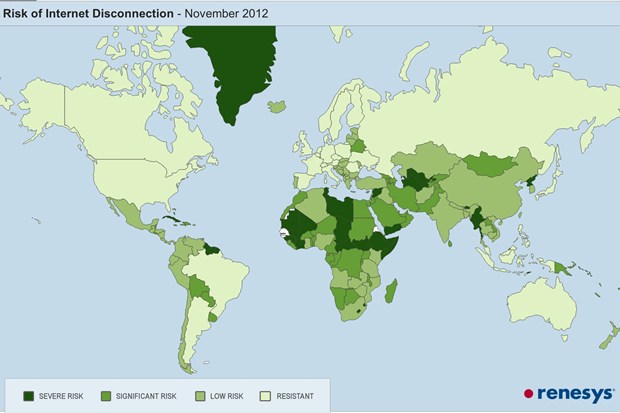
The 61 countries that could easily be unplugged from the internet

 http://www.wired.co.uk


It's becoming the trademark move of failing regimes: silence your critics and cripple their communications by cutting off the internet. Libya did it. Egypt too. And last week, Syria pulled the plug on its own internet system.

According to new research from network monitoring company Renesys, it could just as easily happen in many other countries too, including Greenland, Yemen, and Ethiopia. Sixty-one of the world's countries have just one or two service providers connecting them to the rest of the internet.

"If you're a sufficiently small place it's almost inescapable that there will be so little internet that it's almost trivial to turn it off," says James Cowie, chief technology officer with Renesys.

On the other extreme, more than 30 countries -- including the UK, Canada and the US -- have over 40 network providers each at their electronic frontiers. They're almost impossible to unplug.

Renesys came up with its map (shown above) of the internet's most easily unplugged countries by studying the Border Gateway Protocol (BGP) tables stored in the memory of the big routers used by hundreds of internet service providers. These BGP tables tell the routers how to hop messages from one network to another, and once you start putting together four or five hundred of these tables, you get a pretty clear picture of how the internet is wired together.

So what makes for an easily un-switched country? "It's a high degree of centralisation and a low degree of diversity," Cowie says. "They tend to be places where naturally or organically though history or through regulation, the number of providers that get to exchange traffic with their foreign counterparts is very, very low."

So Greenland fits the mold. "Greenland probably wishes it had more diversity, but just the nature of Greenland and the expense of getting connectivity into Greenland means that they're limited to a small -- apparently very small -- set of providers," Cowie says.

Interestingly, though, Afghanistan does not.

According to Cowie, the Afghanistan once had a countrywide network. It wasn't great, but when it was destroyed in the war a new network formed like a kind of scar tissue over the country, connecting different regions to Iran, Pakistan, Uzbekistan, and Turkmenistan.

"Afghanistan, in the middle of them, buys internet connectivity from all of them," says Cowie. "So the government in Kabul is not any more capable of turning the internet off than they were of building an internet in the first place."